- Heeft u hulp nodig? +39.0303581121
- Taal Wijzigen ( click )
 Austria
 Belgium
 Czech Republic
 Denmark
 English (world)
 Finland
 France
 Germany
 Italy
Italy Netherlands
 Poland
 Portugal
 Spain
Spain Sweden
 USA
USA


   |
You know Italians for their pasta mania, but even rice is a product we love.
In Italy rice is a first course (risotto) and not a side dish, as you know.
The rice is produced especially in north Italy, where there are plains like the Po valley.
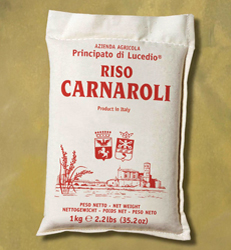
Today I’d like to present you the rice of Principato di Lucedio, another exclusive Italian product.
It all began when a community of Cistercian monks founded the abbey of Lucedio, in Piedmont.
In the surrounding areas they have been cultivated rice since 1400.
The beautiful abbey and its crops changed owners several times over the last few centuries, from Savoy to Napoleon. Today it is the family of Count Wiesenhoff who runs the company, with attention to tradition and quality.
If you pass near Vercelli I recommend you to stop in Lucedio, where you can visit both the historic buildings and the company, and you can also taste risotto and other products.
Risotto seems difficult to prepare, but it’s only a matter of organization: if you already prepared the broth and other ingredients, you’re halfway there.
You must act as a TV chef: prepare sliced vegetables, ham pieces, and everything you need. This is because you have to stir the rice all the time, so you can’t do other things in the meanwhile.
In this way the rice is pretty simple to cook, just remind a few topic moments: sauté the rice (tostatura), the last ladle of stock, and the final mantecatura.
For example, the last time I prepared risotto I had only a zucchini, two slices of ham and an onion.
Usually I use 5.64 oz of rice and 0.26 gal of broth for two people.
When I prepare the sautéed onion and the broth, I’m ready. I know it’s not so good, but you can use a bouillon cube to make it easier.
I cooked the pieces of ham with the onion and then the zucchini.
It’s time to sauté the rice. This process is necessary to caramelize the rice and prevent it from absorbing too much water. It just needs to become a little translucent, not darker or burnt.
Then add a little wine, if you like, and wait until it evaporates completely.
It’s time to add broth: a ladle at a time, keeping on stirring.
Taste the rice before it’s ready (control the cooking time on the box). When it’s still firm but not crispy, it’s done. The broth must be absorbed; for this reason you can add only a ladle at a time.
Add a dab of butter (as big as a walnut) and do the mantecatura: stir the rice with the butter to make it creamy. Then serve with a sprinkling of Parmesan cheese.
As the most part of Italian recipes, eat it while is still hot. That way my grandma defines “cotto e mangiato”: ‘cooked and eaten’.
